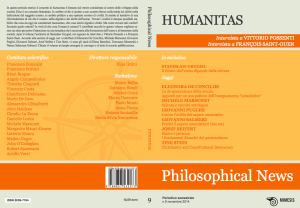


9.10 Josef Seifert, Essere e Persona. I fondamenti filosofici del personalismo
Click here for the download
Abstract:
Philosophical personalism consists first of all in the recognition of the superior dignity of the person compared to all other kinds of being. Consequently, any philosophy that puts nature, ecological values, wealth, or other things above persons, is opposed to personalism or even anti-personalistic. Such antipersonalism often takes the form of an anti-culture of death, treating persons as if they were things that can be eliminated if they are not useful economically or for a small group of other people.
Because a person is an individual of rational nature, anthropological philosophical personalism in the last analysis presupposes a human spiritual soul and is incompatible with materialism. Therefore, personalist philosophy carries on an intellectual battle against reducing the person to a collection of cells, to brains, or to animal life. It also resists the reduction of being a person to acting as a person. The rejection of such an identification that would declare a large part of human beings non-persons, is supported by distinguishing the inalienable ontological dignity from three other kinds of dignity that are not inalienable and presuppose the conscious awakening or even an adequate use of intellect and will.
Such a personalistic anthropology has tremendous consequences for ethics.
A metaphysical personalism distinguishes clearly the notion of person and that of man: while all human beings are persons, not all persons are humans, because there are “individual subjects of rational nature” superior to man. Metaphysical personalism thus also includes the insight that being a person is an absolute and pure perfection that also must be found in the most exemplary form in the absolute being, in God. Regarding this and many other aspects of personalism, there are many degrees of perfection of philosophical personalism, many traces of which are encountered in Plato and other Greek philosophers, but which reached its perfection only in medieval, modern and contemporary thought. Many philosophers regarded as personalists such as Kant and Scheler, in the light of the rigorous criteria of philosophical personalism developed in this paper are shown to be only imperfectly personalist thinkers. This paper, as well as the book of the author Essere e Persona constitutes a phenomenological rethinking of the notion of personhood not being restricted to man but being a “pure perfection” that admits of infinite perfection. This notion of “pure perfection found in Anselm, Duns Scotus and developed by the author, plays a key role, without which also human personhood remains inexplicable and incomprehensible.
Personhood also has a profound ethical dimension and can, in ultimate analysis, not be separated from love and the gift of the inalienable self of the person in love.