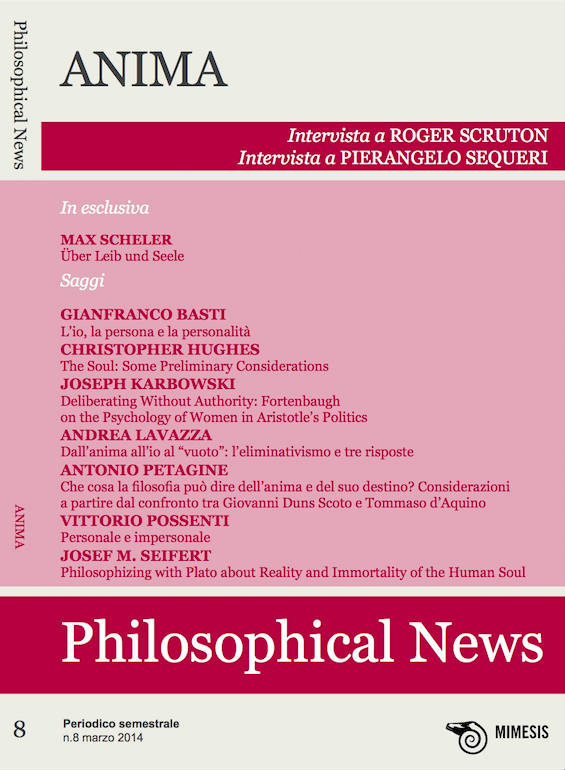


8.11 Josef Seifert – Philosophizing with Plato about the Reality and Immortality of the Human Soul
Philosophical arguments for the immortality of the soul which appeal to our reason have been developed throughout the history of philosophy. But while we do have some impressive fragments of the Presocratics on the human soul, a systematic philosophical investigation into the soul and its immortality begins with, and, at least in ancient philosophy, also culminates in, Plato. I shall try to summarize the most significant Platonic arguments for the immortality of the soul, but not in a merely historical way but in an effort to philosophize with Plato about being itself, searching for what is valid in his arguments and for what is true in their premises and trying to point out some of their weaknesses and strengths. In other words, my ultimate purpose in this paper is to seek the truth about the soul and its immortality.
Some of the arguments Plato develops for the immortality of the soul are simultaneously arguments for its existence, and of these some are good arguments for the reality of the soul but not good, or at least very insufficient, arguments for its immortality. I shall also consider some of the objections raised against the belief in immortality by Ludwig Feuerbach and others, trying to support the valid Platonic arguments for the immortality of the soul by new reasons put forward against these objections. Moreover, at the risk that my opinion that there is a philosophia perennis in the sense of the valid contributions of philosophers of all schools and times might be considered ahistorical, I will show that the deepest though less developed reasons for the Platonic teaching on the immortality of the soul are personalistic arguments very much comparable to those presented by Max Scheler, Gabriel Marcel, Dietrich von Hildebrand and others in the last century.